

You've been invited to join
a community that learns together.
ASCEND is a non-profit dedicated to advancing family well-being in a digital age by increasing economic mobility. You've been invited by someone who believes it would be both good for you, and good for all of us. We learn by doing. How we do things is as important as what we do. Together, we learn.
As we grow, we've discovered three key ideas that we find so valuable that we say them out loud:
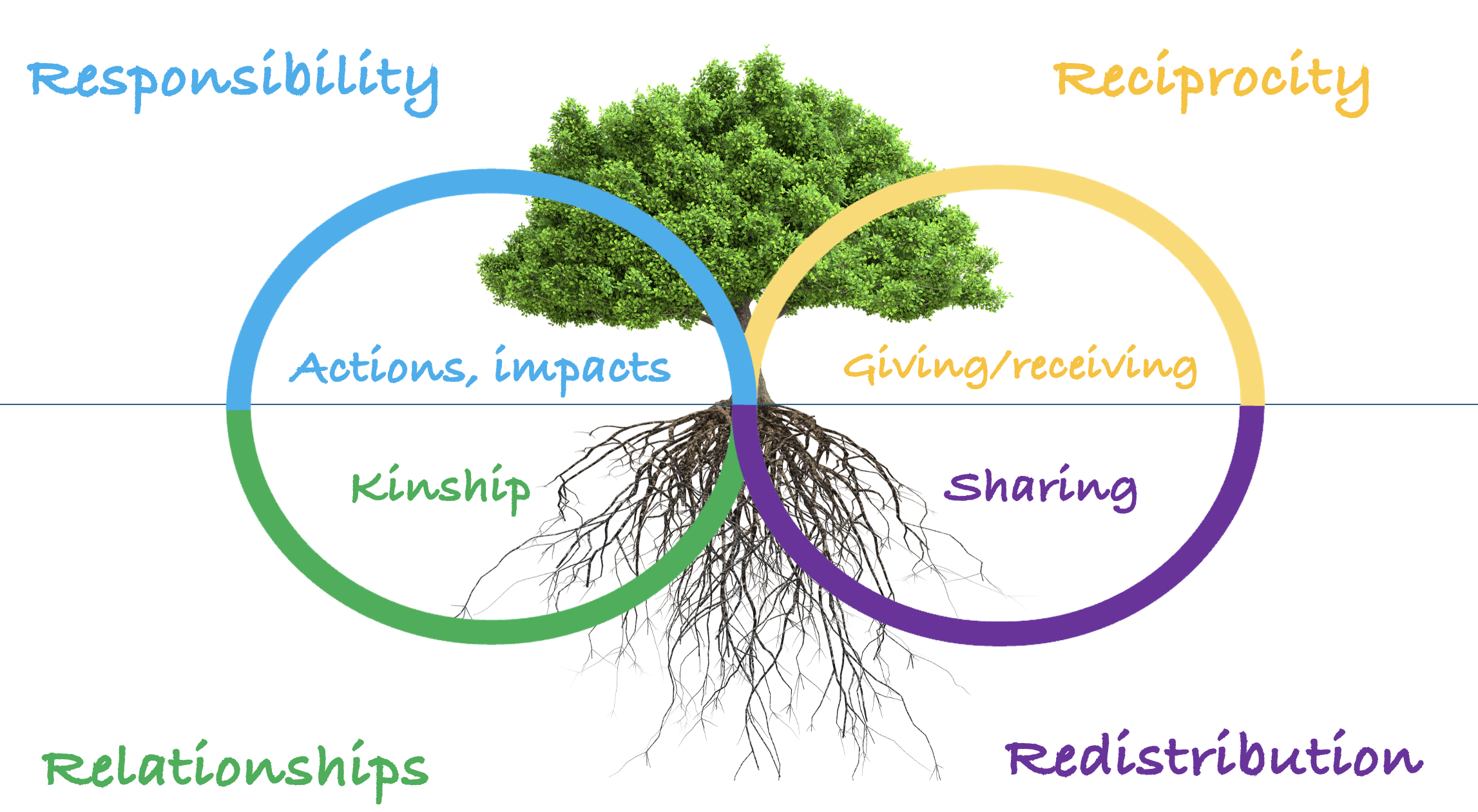
Learning, UnLearning, ReLearning — Unforgetting honors the 4Rs: Reciprocity, Relationships, Responsibility, and Redistribution. These qualities represent balanced giving and receiving, strong connections between people, personal accountability, and equitable sharing of resources within a community. Unforgetting is essential today, as we are called upon to create Remedios — help, healing, and solutions.
Rooted in Dr. Gregory Cajete's Indigenous Knowledge Roadmap work at NMHU, our project operationalizes the model put forward in Keeping Track: A Toolkit for Indigenous Youth Program Evaluation — grounding Learning by Doing in Youth Participatory Action Research within an intergenerational, community-focused process.
"…it is the depth of our ancient human participation with nature that has been lost and indeed must be regained in some substantial form in modern life and modern science. The cosmological and philosophical must once again become 'rooted' in a life-centered, lived experience of the natural world."Cajete, 2000, pg. 5
Add NextREADY GPS
to your OST program
to showcase the powerful learning
your participants experience.
ASCEND is a participant in the Northern New Mexico STEAM Coalition and contributed to the development of the STEMinNM Framework. Whether or not NextREADY GPS was part of your original proposal, your participants are already doing the work — we give them the language to name it, the tools to document it, and a community to grow in.
"STEMinNM creates the conditions for STEM engagement.
ASCEND creates the conditions for STEM identity."
This capacity-building resource is funded by the McCune Charitable Foundation.
Now Recruiting: McCune Durable Life Skills Project, 2026 · ASCEND is recruiting 200 participants by nomination through OST providers and schools in our seven-county McCune territory: McKinley, San Juan, Santa Fe, Chaves, Doña Ana, Sandoval, and Taos. When an OST provider or school nominates participants and joins the project, that relationship itself creates the community engagement and consortium documentation needed for future funding cycles — without requiring a separate fiscal agent structure.
Same students. Same communities.
Sequential and reinforcing missions.
ASCEND participated in the development of the Northern New Mexico STEAM Framework alongside 75+ coalition partners. The alignment below reflects a shared philosophy about whole-student development, cultural and linguistic responsiveness, and what it actually takes for a young person to build a durable relationship with STEM learning.
Light Touch · YPAR Approach
Adding NextREADY GPS to your program is intentionally low-burden. Because ASCEND uses Youth Participatory Action Research (YPAR), students are reflecting on experiences they've already had in your OST program — not completing a separate assessment. The penny drop session is a welcoming entry point: students place a penny on a bilingual sheet to document what they already know and can already do. Your program provides the STEM experience; NextREADY GPS gives students the language to name it and the evidence to show it.
Expand access to high-quality STEM learning for New Mexico students — especially those in rural, tribal, and underserved communities. Build a statewide network capable of delivering equitable STEM experiences outside the school day.
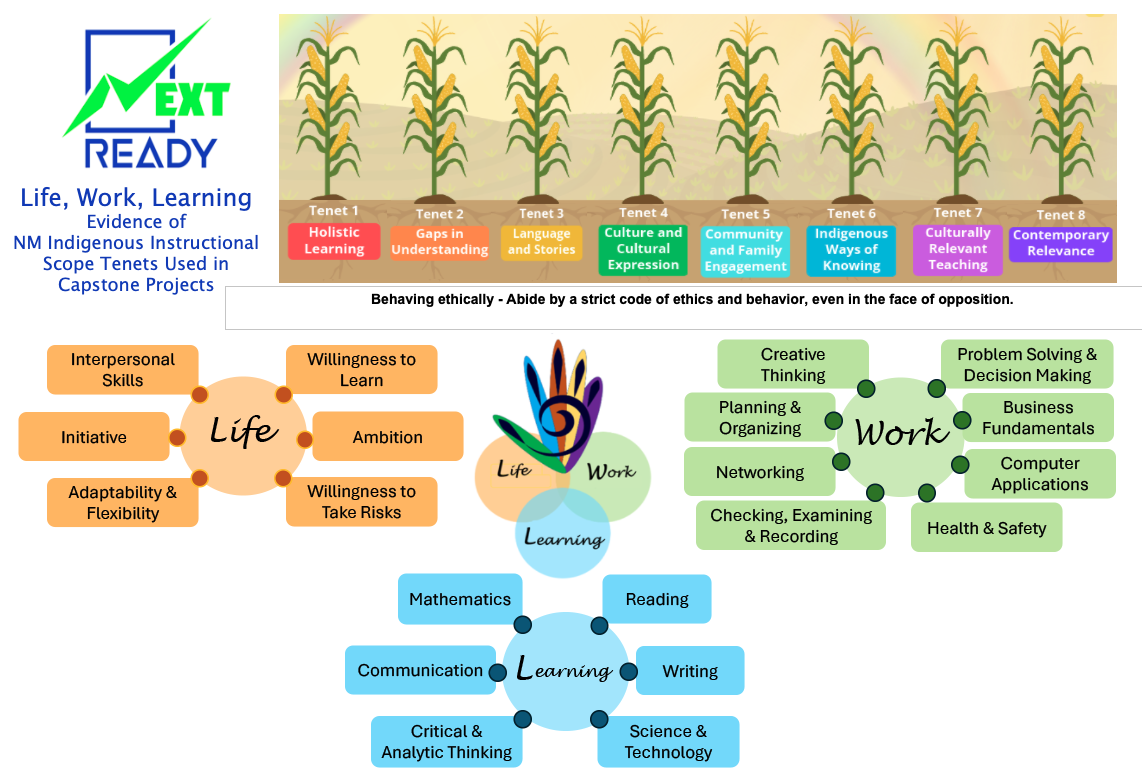
Develop the learning identity, durable life skills, and career readiness of individuals and families through evidence-based, culturally responsive tools. Committed to the students at the heart of the Martinez/Yazzie lawsuit and aligned to the NM Indigenous Instructional Scope and Sequence.
Both organizations serve the same students, outside the school day, with equity as the organizing principle. The curiosity, agency, identity, and persistence that STEM learning requires to be sustained — these are exactly what NextREADY GPS is built to document.
ASCEND creates the conditions for STEM identity.
NM Indigenous Instructional Scope & Sequence
Your Program Is Already
Generating This Evidence
Think about what happens in a quality OST environment. A student builds something. Tests a hypothesis. Connects hands-on skills to something they care about. Every one of those moments is a Durable Life Skill in action — and NextREADY GPS gives students the language to name it and the documentation to show it.
50 Fridays —
a year of learning together
Whether or not NextREADY GPS was part of your original proposal, your participants are already doing work worth documenting. The 50 Fridays cohort is how OST programs join a living community of practice — organized as four quarterly cycles, with all four life stages present simultaneously, and community as the natural evaluator of its own experience.
Establish the team. Seat the knowledge keeper. Name the evaluation question. Youth identify what's worth asking — and who in the community holds the answer.
Field weeks. Interviews, observation, building. Youth conduct research they designed. Elders are informants, not authorities. Every Friday produces a deliverable that enters the logbook the same day.
Public presentation and the Elder's witness record. Youth researchers present findings to community members, school boards, funders. The harvest meal is where the real data lives.
Results shared back to the people who generated them, in the format the community chooses. Knowledge moves outward from youth to the broader community — redistribution of intellectual capital.
Penny placement, prototype, drawing. Youth are not the subjects of inquiry — they are the researchers. They identify the questions worth asking, design the data collection, analyze what they find, and present to the community.
iCAN statements, digital stories, 4E Story drafts. When adolescents present their findings to a town council, the knowledge-authority gradient reverses. The youth have done work the adults haven't.
PhotoVoice, family conversation records, peer review of Capstone Journals. A parent who hauls water or tends livestock names the engineering problem before the students have named it themselves.
The Elder doesn't teach the youth — the Elder witnesses the youth. Session observations are logged. The Elder Approval gate protects community knowledge before it publishes to the ArcGIS StoryMap.
The community informs purpose, goals, and the questions to follow. The ABCD&E Model engages all four life stages in answering together.
How are we informed? How do we ensure our data are correct and our community values are honored in all aspects of our work? The 50 Fridays model insures intergenerational collaboration by design.
What is our roadmap? What is our direction? How do we take our first steps? The quarterly cycle provides the structure; community provides the direction.
What were our expectations and what was the ultimate reality? StoryMaps facilitate the convergence of stories, data, and evidence — making community knowledge visible and permanent.
How do we articulate what was done and draw more stakeholders in? The 50 Fridays community meal gatherings embed this as a reliable, regularly scheduled experience.
"See, look at the paintings. Look at the way we're doing it, keeping track."
— ZYEP program advisor and Zuni artist
Durable Life Skills Webinar Series
We are not training people to deliver a program — we're training people to become a certain kind of witness. An Elder in this framework isn't a subject matter expert who presents — they're someone who can name growth when they see it. A YPAR coach isn't a research methods instructor — they're someone who can sit on their hands while a 16-year-old designs a flawed survey and resist the urge to fix it, because the learning lives in the iteration.
Durable Life Skills · Penny Drop Sheet
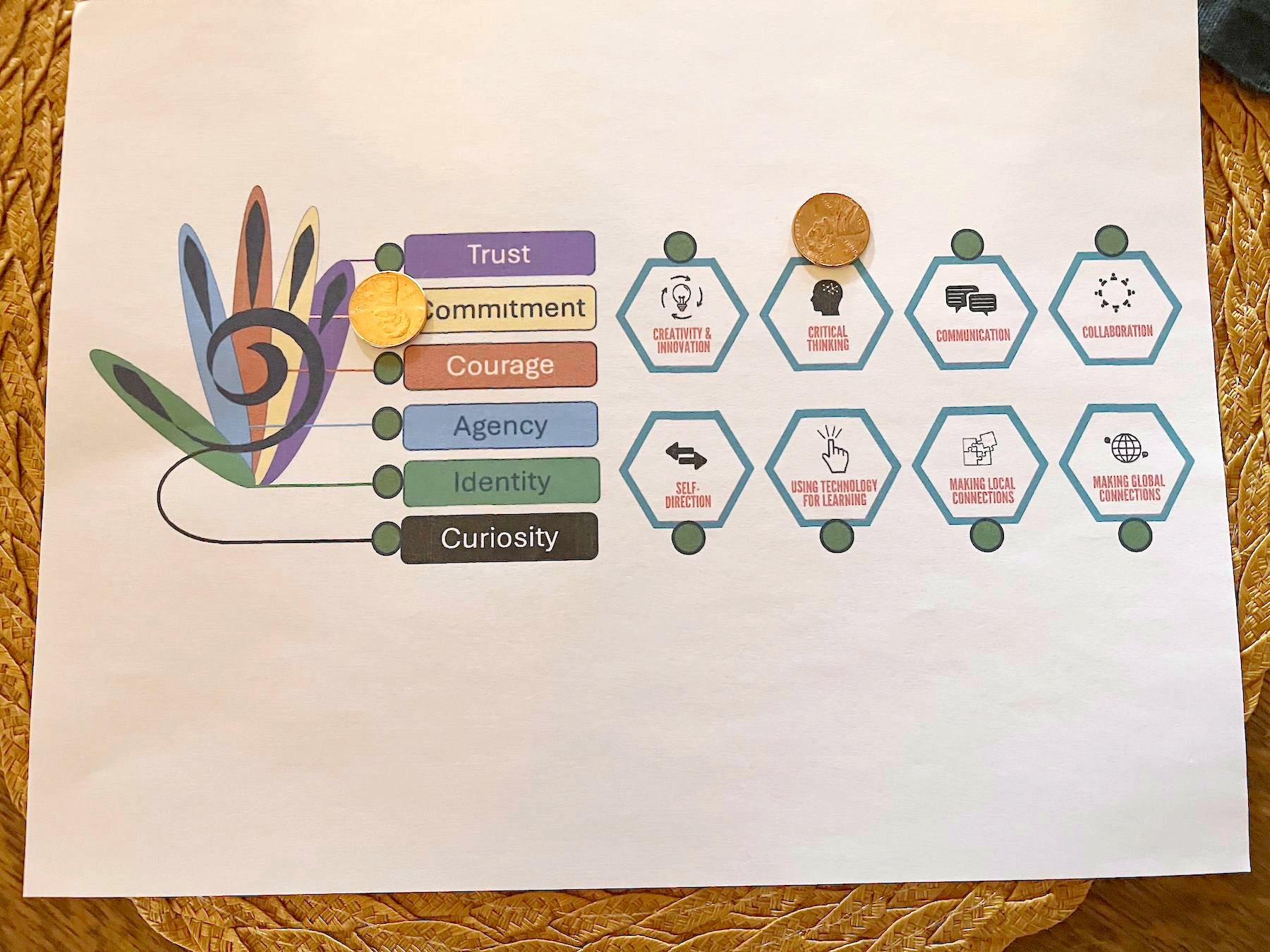
Each webinar produces one artifact that will be used in the actual program. By the end, participants haven't just been trained — they have a small portfolio of the kinds of evidence the program will ask them to generate. Youth are not the subjects of inquiry — they are the researchers. They identify the questions worth asking, design the data collection, analyze what they find, and present to the community.
A community conversation anchors this session: community members share stories of how their families and neighbors have always kept track — grandmothers who tracked weather patterns, coaches who remembered every kid's story. By the end, participants understand that the Six R's (Remembering, Reclaiming, Reconnecting, Respect, Responsibility, Relationships) are not a new framework being imposed — they are a description of what good communities have always done.
📄 Artifact: Body map of what participants already know and can doA structured fishbowl exchange runs with a specific prompt: What is something you know now that you wish someone had told you at 15? And what is something a young person has taught you recently that surprised you? The first question opens Elder-to-youth knowledge flow. The second reverses it — and the reversal is the teaching. Elders who struggle with the second question are encountering exactly the disposition shift YPAR will require of them.
📄 Artifact: Intergenerational knowledge exchange recordThe facilitator models a Listening Circle opening, then breaks into small groups where participants take turns holding the facilitator role. The community conversation prompt: Name one thing you witnessed this past week — in a child, a neighbor, a colleague — that was a sign of growth. Not an achievement. A sign of growth. This teaches the distinction between outcome measurement (Western evaluation) and growth witnessing (Keeping Track). The 4E Story frame is introduced: Educational, Entertaining, Efficient, Evocative.
📄 Artifact: Draft 4E Story from a real observationA case study discussion presents two versions of the same YPAR moment: one where an adult "helped" a youth researcher redesign their survey question, and one where the adult held back and the youth revised it through iteration. The discussion surfaces the central tension YPAR coaches must learn to hold: quality of data versus ownership of inquiry. Your job is not to help them get the right answer — your job is to make sure they own the question.
📄 Artifact: YPAR coaching practice logWhen an Elder reviews a Capstone Journal entry or a 4E Story before it publishes to the ArcGIS StoryMap, they are exercising sovereignty over community knowledge — asking: Is this story accurate? Is it told in a way that honors the people in it? Is it telling outsiders what our community wants outsiders to know? The community conversation: What is something about your community that outsiders consistently misunderstand? What would it mean for young people to be the ones who correct that misunderstanding — in public, with data, on a map that anyone can find?
📄 Artifact: Completed Elder review of sample community storiesHow ASCEND Strengthens
Your STEMinNM OST Program
Already Funded? NextREADY GPS doesn't require a new grant cycle to deliver value. If your program is operating under a 21st CCLC or OST award, the tables below show exactly how NextREADY GPS generates the evidence your funder already expects you to collect — and how joining the McCune cohort positions your program for the next five-year cycle.
| Program Requirement | What's Required | ASCEND–STEMinNM Response |
|---|---|---|
| Program Purpose ESSA Title IV-B | Provide academic enrichment and youth development outside the school day. | NextREADY GPS Durable Life Skills framework provides the youth development documentation layer that STEMinNM's programming delivers. The iCAN framework connects enrichment to learner-owned academic goals. |
| Family Engagement | Minimum two family engagement events annually; welcoming and culturally responsive approaches. | ASCEND's family learning approach and Hand of Learning frame provide STEMinNM member programs with a structured, culturally responsive framework for family engagement that goes beyond events to sustained learning conversations. |
| Evaluation & Continuous Improvement | Local needs assessment, measurable objectives, evidence-based strategies, data for ongoing improvement. | NextREADY GPS penny assessments provide pre/post data. MasteryIndex scoring with Cronbach's α >.90 satisfies evidence-based strategy requirements. DOK progression data enables continuous improvement cycles. |
| Data Reporting 21APR | Collect and submit student attendance and outcome data through 21APR system. | ASCEND's session-level data architecture (SessionID, TeamID, timestamped GPS coordinates) generates the participation records required for 21APR. Durable Life Skills outcomes map to NM State Performance Indicators. |
| Partnership Requirement | Demonstrate active collaboration among schools, LEAs, CBOs; provide MOUs. | The ASCEND–STEMinNM MOU provides the documented partnership required. STEMinNM's existing LEA relationships across its member network satisfy the school collaboration requirement. |
| Consortium Model+75 pts | Two or more eligible entities jointly plan and implement under a single fiscal agent. | When an OST provider or school nominates participants and joins the McCune Durable Life Skills project, that participation creates the documented consortium relationship for future funding cycles. No separate fiscal agent structure required. |
| Rural, Tribal, Underserved Access+75 pts | Expand access for students in rural, tribal, or geographically underserved communities. | STEMinNM's existing presence in tribal and rural communities — combined with ASCEND's bilingual penny assessments, culturally responsive 4Rs framework, and alignment to the NM Indigenous Instructional Scope and Sequence — directly satisfies this priority. |
| Organizational Capacity150 pts | Leadership structure, staffing plan, experience serving target population, capacity to manage grant. | NextREADY GPS is a 15-year FileMaker-based platform — not a prototype. Validated psychometric tools (Cronbach's α >.90, Ravitz/Gerry/Heine, AECT 2022) and McCune Foundation grant credibility demonstrate organizational readiness. |
| Innovative Enrichment+25 pts | Innovative enrichment supporting STEM, arts, career exploration, experiential programming. | STEMinNM's core programming IS innovative STEM enrichment. NextREADY GPS adds the career readiness layer (D-CAR competency, SOC-linked aspiration mapping) that elevates enrichment to career pathway development. |
| NM State Performance Indicator | NextREADY GPS Evidence Pathway |
|---|---|
| Academic Achievement Reading & Mathematics improvements | NextREADY GPS Durable Life Skills sheets include D-LRN (Lifelong Learning) and D-LIT (Literacy) competencies. Pre/post penny placement documents movement along validated skill scales. DOK level progression documents deepening academic engagement from recall (DOK 1) through extended thinking (DOK 4). |
| School-Day Attendance Reduced chronic absenteeism | The iCAN framework and Hand of Learning (particularly Agency and Commitment dimensions) address the motivational and identity factors underlying chronic absenteeism. This connection is central to serving students at the heart of the Martinez/Yazzie lawsuit. |
| Student Engagement Participation in enrichment | MasteryIndex scores document sustained engagement over time. Capstone Journey Journal portfolio entries provide artifact evidence of deepening participation. MasteryIndex validated to Cronbach's α >.90 (Ravitz/Gerry/Heine, AECT 2022). |
| Family Engagement Increased family involvement in student learning | ASCEND's family learning approach generates documented family engagement touchpoints. The iCAN framework creates family conversation structures that are recordable as engagement events for PED reporting requirements. |
Two Partnership Pillars
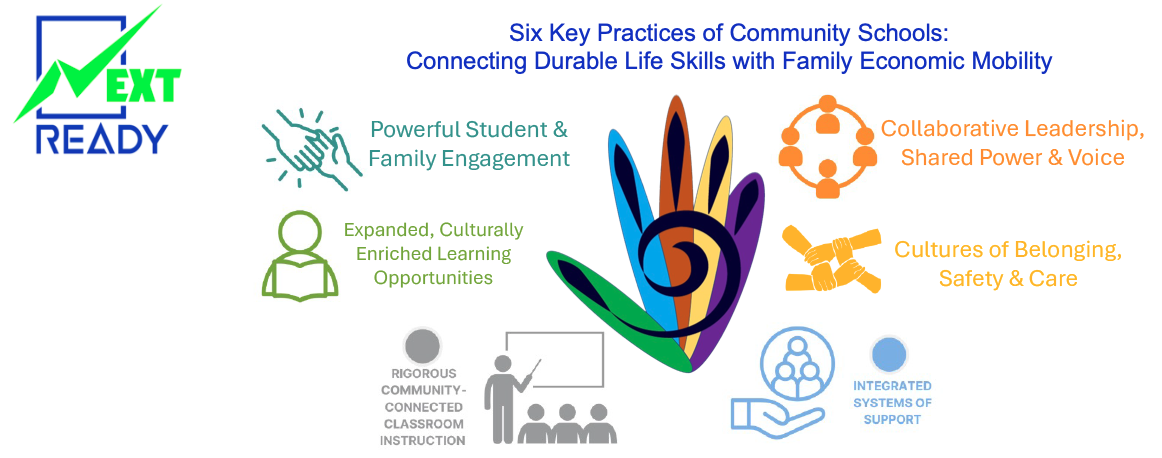
Community Schools · Six Key Practices
Your program delivers the STEM learning environment — the activities, mentors, projects, and community context. You nominate students to join the McCune Durable Life Skills project. That's the partnership.
ASCEND brings the YPAR-based NextREADY GPS system. Students reflect on their OST experiences using penny drop sessions and iCAN statements. The documentation happens; your program gets the data.
When your OST program or school joins the McCune project, that participation by definition creates the community engagement and consortium documentation you'll need for future funding cycles. You're not building a grant relationship — you're building a program relationship that generates grant documentation as a byproduct.
When OST programs use NextREADY GPS as their shared navigation and documentation platform, three durable outcomes follow:
- A shared data architecture enabling network-level outcome reporting no individual program could generate alone
- A common language for learner development — curiosity, agency, identity, persistence — spanning diverse STEM programming contexts
- An evidence base supporting 21st CCLC, McCune Foundation, and other NM funder reporting requirements across multiple cycles
Youth Participatory Action Research means students are the researchers of their own experience — not subjects of an external assessment.
- Students reflect on STEM experiences they've already had in your program — no separate assessment sessions required
- The penny drop is a welcoming entry point, not a test — bilingual, culturally responsive, designed for OST contexts
- iCAN statements give students ownership of their own evidence — transforming participation into documented learner agency
- Your program provides the context; NextREADY GPS provides the language and the record
An entire ecosystem
for family learning
NextREADY GPS is not a program tool — it's a living navigation system for families at every stage. OST programs are one entry point. There are four more.
Your participants are
already doing this work.
NextREADY GPS gives them the language to name it, the tools to document it, and a community to grow in. Join the 50 Fridays cohort — open to any OST program, regardless of whether NextREADY GPS was part of your original proposal.