Contemplative traditions across history and around the world use music to take us inward — to understand and experience our inner lives — and then to emerge better able to connect with our communities. The woodshed is the THROUGH made physical. It is where the bad notes come out. Where the clock resets on the fourth time. Where doing the same thing is the biggest mistake. Where improvement is possible — not because it is easy, but because you stayed. You practice solo first. Then in pairs. Then in combination — because the skill that holds under pressure is the one built in all three.
ASCEND / NextREADY GPS · Remedios
Music, without a word, lets us experience emotions, ideas, and flow.
Playing the
Changes
From→Through→To — a learning trajectory

Playing the Changes is where we transform fear of change into freedom to change — while learning the nature of our minds. Making creativity, innovation, and compassion a way of life, especially in times of chaos. Not improvisation as chaos — improvisation as the highest form of preparation meeting reality.
"My first language is music. I'm so grateful that this universal language provides bridges for us to connect with our common humanity."
— Ferdi Serim, Founder ASCEND
Remedios: help, healing, solutions. This is the first practice.
Ferdi Serim · Founder, ASCEND · 3 min · Subtítulos en Español
Play the Changes — rather than having the changes play you.
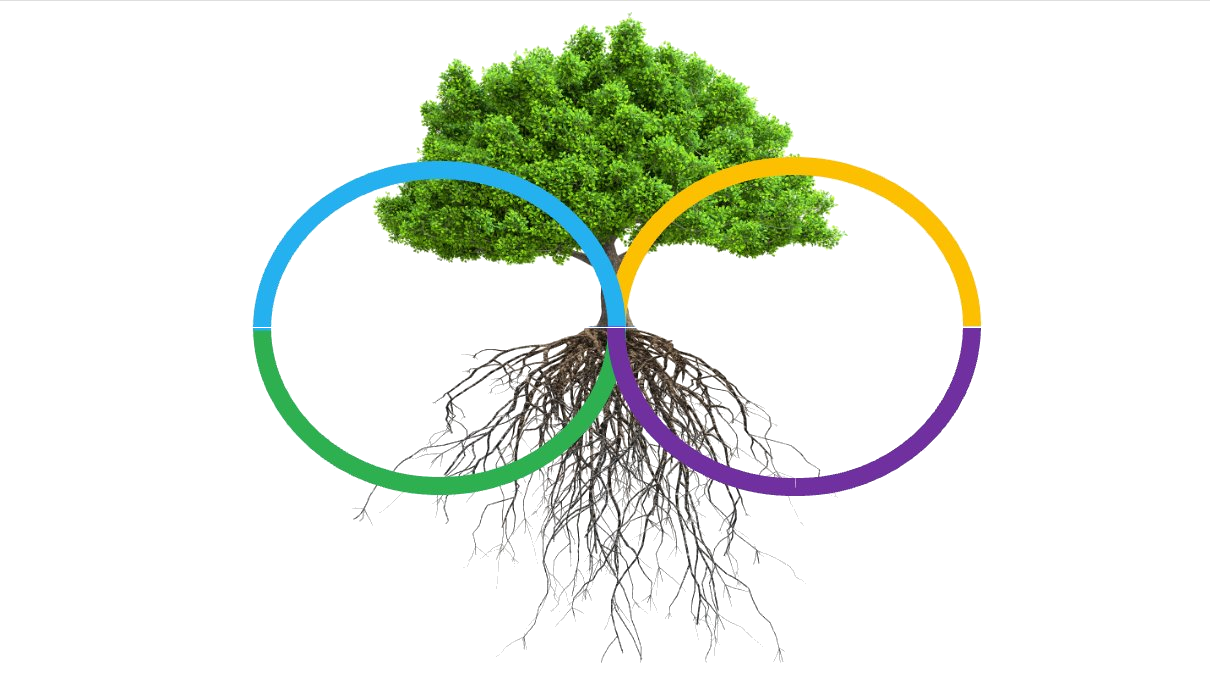
Reading the image
From — Through — To
Left circle
From
Me
Me
Where you started. Your prior knowledge, your identity, your community, your history. The individual learner's full self — not a blank slate but a specific person from a specific place. Our lives become our personal works of art, deepened by starting where we are.
Center — The Hand
Through
The instrument of passage. Five fingers rising from the spiral. The place where the journey actually happens — where mistakes are made and learned from, where the woodshed is, where REST lives.
Right circle
To
We
We
The community. The shared destination. Where the work lands, where it is witnessed, where it enters the library. We listen to connect — with unwavering presence — discovering and adding our uniquely personal and authentic voices to our collaborations. You do not arrive here by leaving yourself behind — you arrive by traveling fully through.
"From→Through→To" is the whole arc made into a single gesture. The "To" is doing real work. It holds toward and through together, because in practice you cannot separate them. The moment you commit to a direction, you are already moving through something.
The colored arcs that form the fingers of the Hand are not decorative. They are the Four Rs — the Indigenous ethical ground in which the whole tree grows. Blue for Responsibility. Green for Relationships. Gold for Reciprocity. Purple for Redistribution. They are not added to the Hand. They are the Hand's color, its texture, its relational nature.
You do not travel from Me to We by leaving yourself behind. You travel through the development of your capacities — your fingers — which are always already relational. The Hand is not between FROM and TO. It is the instrument through which the journey happens.
Try it yourself · Pruébalo tú mismo
The Hand of Learning
Six elements. Six edges. Drag each description to its place on the hexagon — and see the Hand come alive.
The Hand of Learning
Each finger of the Hand represents a different element of how we grow. Drag each description to the matching edge of the hexagon.
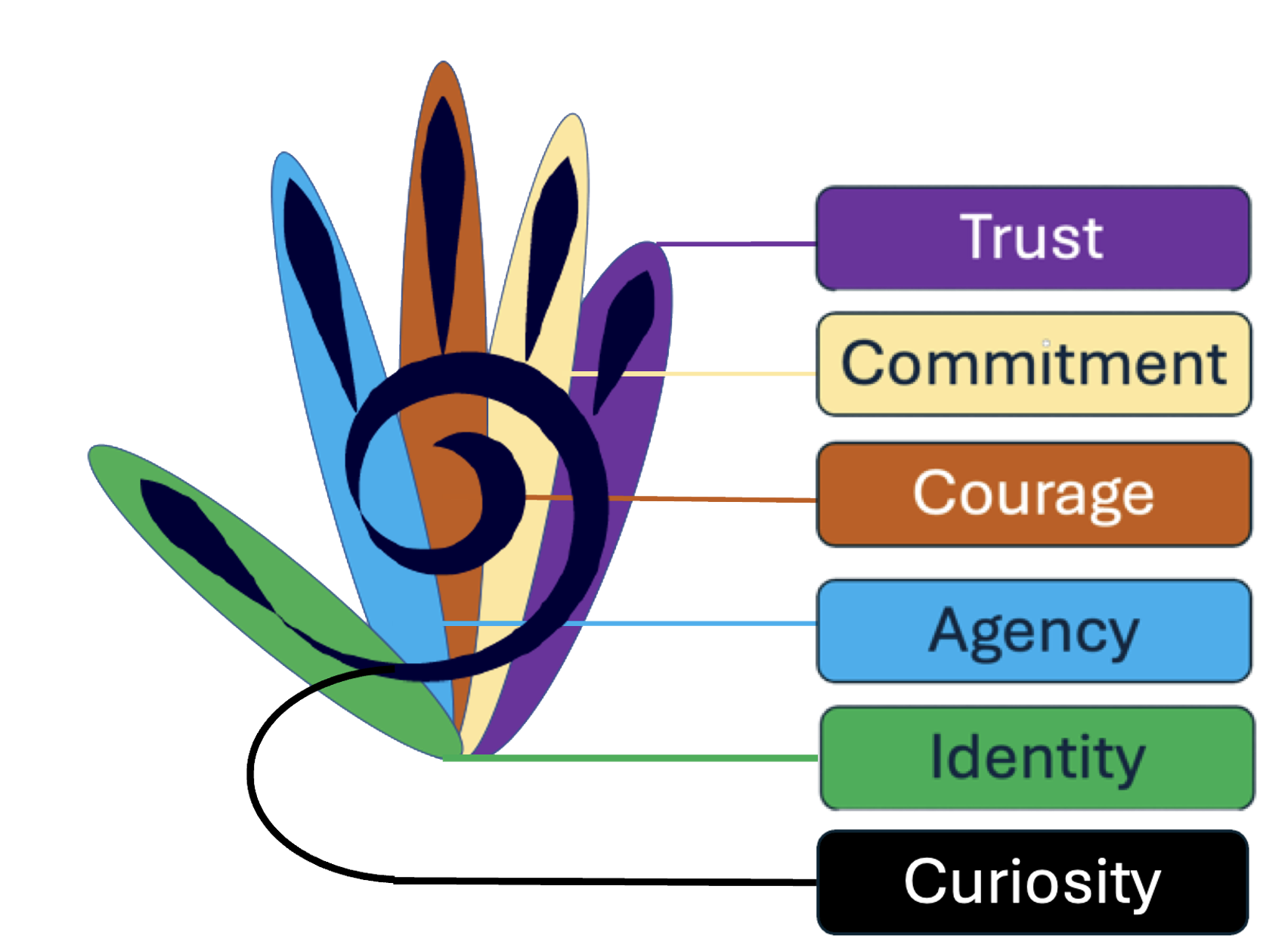
the hand of learning
drag to the hex →
0/6
drag a card to its edge
All six matched — you know the Hand!
¡Conoces la Mano!
¡Conoces la Mano!
The harmonic structure
From→Through→To is the ii–V–I (said two, five, one)
Playing the Changes is as simple as this: moving from here (point of origin, or the ii) to here (point of destiny, or the I) through here (the bounce, or the V). In music, the destination is the home key. The pivot — the bounce — is where you decide to change direction from where you started. When spoken, it sounds like "two, five, one."
Many of the changes we fear most are not events — they are feelings. And navigating feelings works exactly the same way. The magnitude of emotions shown on the Feelings Wheel mirrors the complexity of John Coltrane's Cycle of Fifths, which shows musicians how all the tones in five octaves are related. When we navigate our feelings toward a desired state, it is rarely a straight path — from sad to happy, for example. Usually you need to bounce. Sometimes more than once.
Navigating the Feelings Wheel: The Bounce

The ii–V–I is a most important harmonic movement in jazz — not just as metaphor but as precise structural description. It is the reason the music resolves. It is also the reason growth is possible.
Playing the Changes is the jazz practice of improvising through harmonic shifts (chord changes) — finding the note that's true in the new context. You don't play what you planned, you bounce — you pivot. You play what the moment needs, using everything you know. That's not improvisation as chaos. That's improvisation as the highest form of preparation meeting reality.
From
the ii
Through
the V point
To
the I
Departure. Tension already pointing. Cannot stay here.
Maximum tension — and maximum possibility. Where choices are made.
Resolution. The community. Arrival at a new vantage point with new horizons.
You have to go down to get up. The V is the bounce, the pivot, the path.
This is why the program is called ASCEND — the ascent is the movement from the V back up to the I, earned by having gone all the way down to reconnect with the roots. You cannot ascend without intentional, purposeful descent. The pedaling downhill to store energy for the next hill. The minor leagues for two days before coming back up. The clock that resets on the fourth time.
The Hand in the Playing the Changes image sits exactly at the V point — the lowest, deepest moment of the arc. The fingers rise upward from there. The spiral is at the bottom. The Hand does not float above the journey. It grows from the deepest part of it.
And in jazz, the resolution is never final. The I immediately becomes the ii of the next chorus. The cycle turns. From→Through→To begins again — from a higher place, with more of the library behind you.

The emotional pivot
The Blues is a force for freedom.
The blues is at the heart of jazz improvisation and has provided the heartbeat for social action for centuries. It is the emotional pivot that can transform suffering — not by denying it, but by giving it a form, a voice, and a direction.
Jazz and Buddhism share the same deep goal: freedom. In jazz, it is freedom of expression, freedom from oppression, freedom to make new choices. In Buddhism, it is freedom from suffering, freedom from ignorance and delusion. The blues is where those two freedoms meet — in the V, at the deepest point, where the only way out is through.
Freedom in Jazz
- Freedom of expression
- Freedom from oppression
- Freedom to make new choices
Freedom in Buddhism
- Freedom from suffering
- Freedom from ignorance
- Freedom from delusion
Responsibility
Actions · Impacts
We are accountable for what our actions do in the world. This is the blue arc — the commitment that runs through every move you make in the passage.
Relationships
Kinship · Connection
We are defined by our connections, not our independence. The green arc — the living web that makes FROM and TO meaningful to each other.
Reciprocity
Giving · Receiving
All relationships involve exchange. Nothing is one-directional. The rust arc — the flow between the learner and the community, always moving both ways.
Redistribution
Sharing · Abundance
Abundance is meant to move. Hoarding breaks the system. The purple arc — what makes the community library possible. Knowledge that comes back.
The Four Rs — rooted in the Tree · expressed through the Hand
See it in motion · Míralo en movimiento
Playing the Changes — Maria's Trajectory
Follow Maria from Communication through Interpersonal Skills to Teamwork — including a Revise/Resubmit move and the bounce back. ▲ ascending · ▽ unlearning. The delta tells the story.
The Learning Trajectory
The V — in practice
the ii → the V → the I. You cannot draw a straight line from From to To. The descent to the V point is not a detour. It is the only path.
From
ii
ii
Where you started
Your prior knowledge, your identity, your community. The specific person from a specific place. Not a blank slate — a full self with history, language, relationships. This is what you bring into the woodshed.
Toward
The direction committed to
Your goal, your aspiration, the community you're moving toward. The moment you name your direction, the passage begins. Toward and Through cannot be separated — committing to a direction means you're already in it.
Through
V
V
The V point — where you are right now
The deepest point. The dominant. Maximum tension — and maximum possibility. This is where choices are made and trajectories decided. This is where mistakes become learning: in the woodshed.
To
I
I
The community
Where the work lands. Who witnesses it. The StoryMap, the Knowledge Keeper, the Elder Approval gate, the community library. You don't reach TO by skipping THROUGH. The community's trust in what you bring is earned by what you actually went through.
↺
The cycle turns
Each completed arc of From→Through→To is one turn of the cycle. The community library grows. The next student begins their FROM with the evidence of everyone who came before. Playing the Changes, together, over time.
The three refuges
Welcome to the Woodshed.
"The heart of the practice is intention and attention. That is all."
— Tara Brach, quoting her Buddhist teacher
In Buddhism, practitioners take Refuge in three things: the Buddha, the Dharma, and the Sangha — the teacher, the teaching, and the community. In Playing the Changes, we take refuge in three things of our own.
First Refuge
The Woodshed
A place of intention and attention — a refuge for practice. The woodshed is where you go to work out your errors, outside of hearing by anyone else. The path to improvement includes many ugly sounds, offering many mistakes to learn from. There is discomfort in growing, as well as effort. Think of it as a gym to develop and strengthen your personal, interpersonal, and intrapersonal skills — practiced solo, in pairs, or in combination.
Second Refuge
The Blues
The blues is the emotional pivot that can transform suffering. At the heart of jazz improvisation, it has provided the heartbeat for social action for centuries. The blues does not deny pain — it gives pain a form, a voice, and a direction. It is the force that makes the descent survivable and the ascent possible.
Third Refuge
The Bandstand
The bandstand is a sacred place. All the ancestors who ever played are with us, watching, every time we step onto it — all those who made it possible for there even to be a bandstand. We honor the ancestors by bringing our best. What we build in the community library is our bandstand. The StoryMap is where we step forward.
Not only our personal, but our interpersonal and intrapersonal skills are all called upon when we practice as individuals, pairs, or in combination. The woodshed is not solitary confinement. It is the place we become ready.
5
Take Five.
Give Five Minutes.
The brave space within the Through
Sometimes you pedal really hard going downhill to get up the next hill. Sometimes you need to spend a while at a lower level of intensity. This is where the REST comes in.
"Notice how each moment has a beginning that touches the past,
an end that touches the future,
and a middle with a duration."
— Scott Snibbe
The REST protocol
Just do nothing, for five minutes.
In between everything else.
With a before, and an after.
In between — peace.
No speech. Only listening.
In between everything else.
With a before, and an after.
In between — peace.
No speech. Only listening.
The REST is not a reward at the end of a hard session. It is a threshold — the before that makes the after possible. The only moment in the entire system that explicitly opts out of generating evidence. Just the pause that makes the before and the after meaningful at all.
An Invitation to Brave Space — Micky Scottbey Jones
Together we will create brave space
Because there is no such thing as a "safe space"
We exist in the real world
We all carry scars and we have all caused wounds.
In this space
We seek to turn down the volume of the outside world.
We amplify voices that fight to be heard elsewhere,
We call each other to more truth and love
We have the right to start somewhere and continue to grow.
We have the responsibility to examine what we think we know.
We will not be perfect.
It will not always be what we wish it to be
But it will be our brave space together,
And we will work on it side by side.
Because there is no such thing as a "safe space"
We exist in the real world
We all carry scars and we have all caused wounds.
In this space
We seek to turn down the volume of the outside world.
We amplify voices that fight to be heard elsewhere,
We call each other to more truth and love
We have the right to start somewhere and continue to grow.
We have the responsibility to examine what we think we know.
We will not be perfect.
It will not always be what we wish it to be
But it will be our brave space together,
And we will work on it side by side.
Illustrated by Nadège
The third refuge
The Bandstand is a Sacred Place.
All the ancestors who ever played are with us, watching, every time we step onto the bandstand. All those who made it possible for there even to be a bandstand — whose struggle, whose sacrifice, whose music carved out the space we now stand in. Therefore, we honor the ancestors and bring our best.
The community library is our bandstand. Every iCAN statement, every witnessed story, every StoryMap entry is a step forward into that sacred space. You are not performing for a grade. You are performing for everyone who comes after you — and for everyone who came before, who made it possible for you to be here at all.
The three spaces of practice
Solo
You and the work. The woodshed. Building capacity in private before bringing it anywhere.
Duo
You and a partner. The peer interview, the witness, the honest exchange that deepens both of you.
Ensemble
The community. The bandstand. The library. The place where your work becomes part of something larger than you.
The contribution pipeline
How From→Through→To
builds the community library
Each completed arc of Playing the Changes is a library entry. The interview is not just personal evidence — it is a community asset. The interviewer holds the TO. The interviewee is in the THROUGH. The LS21 code names which finger they're playing through.
F
From — individual
Penny Drop
Student selects the LS21 intersection — 21CTL practice first (the hex), then Hand quality (the finger). The code is named before a word is spoken. This is already an act of self-knowledge.
T
Through — passage
5-Minute Interview
Peer interviewer asks: "Tell me about a moment when [LS code] showed up for you." The conversation is the woodshed made social. The interviewer is a Knowledge Keeper in training. REST available before and after.
→
Through — reflection
AI Coach + iCAN Draft
Transcript goes to the coach with the LS21 code already as context. Coach is not sorting through 48 possibilities — it is confirming or questioning one. Returns a thumb signal and draft iCAN. Student revises until the language is theirs.
W
To — community
Library Entry
LS21 code + student story + DOK level + Knowledge Keeper witness + Elder Approval status. The StoryMap is the public face. The database is the record. The library is the community playing the changes together — over time, across generations, in all the languages those communities speak.
The AI coach accompanies the THROUGH. It cannot be the TO. Only the community can be the TO. The coach's job is to help the student stay honest inside the passage — not to deliver them to the destination.
The blues gives you the power to Play the Changes,
rather than having the changes play you.
Not only is the blues at the heart of jazz — it is at the heart of learning, liberation, and freedom. This is what it means to ASCEND.
Join the Program →Playing the Changes
From Never to Ever
It is Now that transforms Never to Ever.
Savor and share its blessings.