& Neighbors
Baseline
Vocabulary
Statements
Iterations
+ SkillsBank
NextREADY GPS helps students recognize the skills they already have, document where they are, and navigate toward careers that are already part of their community.
At ASCEND, family is not a backdrop to learning — it is the starting point. Every NextREADY GPS journey begins with a conversation with a family member, friend, or neighbor whose career makes the path feel real. That same spirit runs through everything we do: students are always welcome to bring family members to our activities, our public gatherings are hosted in community schools so young parents can participate alongside their children, childcare is provided, and every event includes a shared meal before or after the work session. Learn more about our Family Learning approach →


Before any assessment or activity, each student had a conversation. Maria's cousin is preparing to be a Licensed Practical Nurse at CNM. Diego's classmate enrolls in Software Development next fall. Elena's neighbor trained to be an Electrician right here in New Mexico.
That conversation — the Family, Friends & Neighbors activity — reveals something important: the path they're considering already exists in their community. Someone they trust has walked it. And some of the skills required? They're already using them.
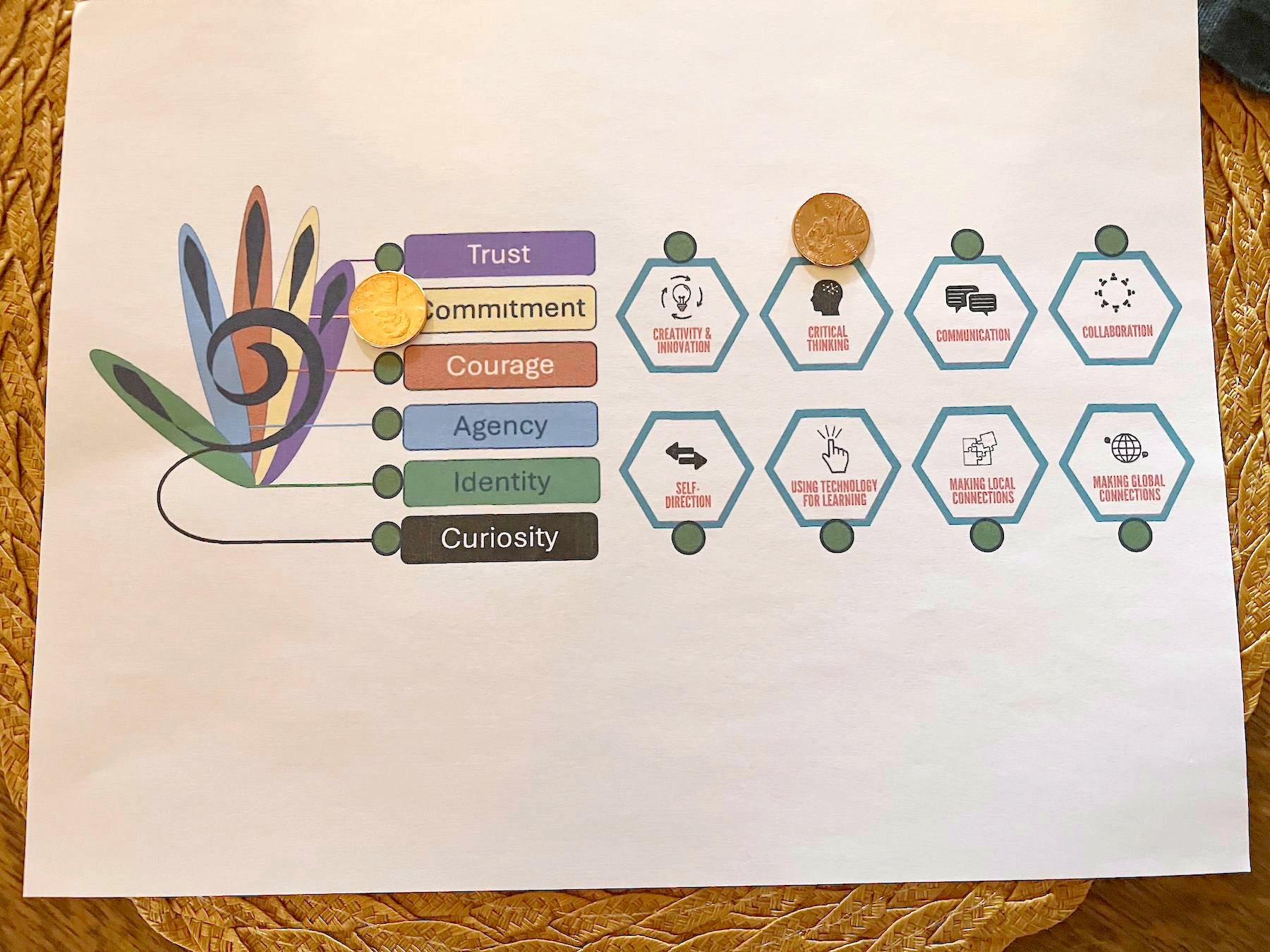
The Penny Drop is a physical activity — simple by design. Students place a penny on a sheet that maps their Durable Life Skills across three domains: how they show up in Life, how they grow through Learning, and what they bring to Work.
Where the penny lands captures two things at once: how much experience a student has with a skill, and how deeply they understand it. That position — their starting point on the learning staircase — becomes their baseline for everything that follows.
Maria discovered she was already using communication skills every day that a nurse uses in a clinical setting. She just hadn't had language for it yet.
Students learn the vocabulary that actually appears in job postings, interviews, and career conversations — organized across four interconnected domains. These aren't abstract concepts. They're the shared language that connects a student's daily experience to the world of work.
An iCAN statement combines a DOK verb, a skill, and a real-world context into a single sentence of evidence. It says exactly where a student is on the staircase — and becomes the foundation for every submission they make.
Every example a student submits is rated at one of four quality levels. Red and Yellow mean: keep going. Green and Blue mean: you're ready to advance. Students continue revising until they reach Green — then they decide where to move next on the staircase.
This is the learning, unlearning, and relearning cycle made visible. Each revision builds the evidence base. Each green unlocks the next step. Students navigate forward — not by passing a test, but by building a real body of work.
After building their initial SkillsBank, each student meets with a Workforce Navigator — someone whose job is to connect what they know to what's available. Together they explore MyNextMove, a national database of over a thousand occupations, and match each student's skills to real job opportunities in New Mexico. What the Navigator sees isn't a test score. It's a living map of each student's journey — their starting point, their evidence, their growth, and their next move. Students, team members, and Workforce Navigators can review the same progress dashboard at any time. Everyone is looking at the same staircase.


NextREADY GPS helps students recognize the skills they already have, document where they are, and navigate toward careers that are already part of their community.