NMSA is the only public school in New Mexico drawing residential students from 40 of the state's most geographically dispersed communities. This proposal uses the HB2 OST grant to build an out-of-school time program that reaches both the students on campus in Santa Fe and their siblings and families at home — connecting them through shared Durable Life Skills development, AI coaching, and a living portfolio that belongs to the learner, not the grant.
"In an ensemble, every player develops individual mastery while contributing to a collective sound no one controls alone. This is not a metaphor for Durable Life Skills. It is Durable Life Skills, performed in real time."
HB2 OST · RFP #2026-14 · Proposals due April 24, 2026 · 4:00 PM MST · Issued by NMPED through CES
Getting students from 40 remote communities into a single high-quality learning environment — NMSA already does this every year. What the HB2 OST grant addresses is the mirror problem: what happens for their siblings and families at home while the students are in Santa Fe, and what happens for the students themselves outside class hours on campus.
A residential public arts high school drawing students from across the state — rural, tribal, geographically isolated. Students living more than 65 miles away live on campus during the school year, creating a unique residential community whose home connections span all 40 communities NextREADY GPS will serve.
An OST program framework built on improvisation as its organizing epistemology — and uniquely suited to NMSA, where students major across six specialized departments: Creative Writing & Literature, Dance, Film & Cinematic Storytelling, Music, Theatre, and Visual Arts. Playing The Changes creates the cross-discipline ensemble context that NMSA's departmental structure naturally provides, while generating Durable Life Skills evidence as part of normal program delivery.
NMSA provides the site and the residential community. Playing The Changes provides a program of Youth Powered Action Research (YPAR). NextREADY GPS provides the documentation layer — connecting what residential students are developing on campus to what their siblings are building at home, through the same skill framework and the same AI coach.
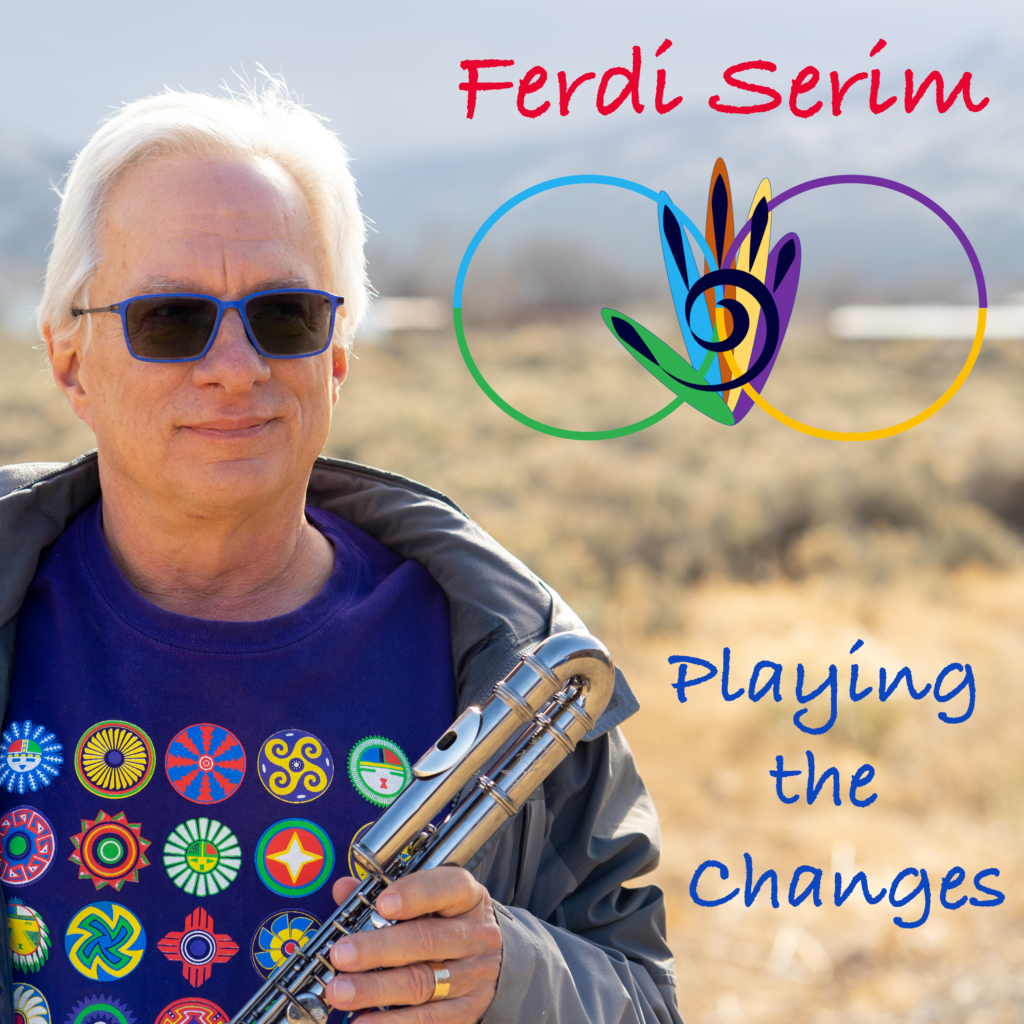
In Playing the Changes, we learn how to use improvisation to transform fear of change into freedom to use change for empowerment through joyful perseverance — the power to persist through the ups and downs of life and practice.
Playing the Changes weaves together jazz improvisation, indigenous wisdom and AI as a Remedios — a Spanish word for healing, help, or solutions — to help us navigate three intersecting worlds: the natural world of ancestral wisdom, the modern "Western" world, and the quantum world of digital and AI.
In Playing the Changes, we learn how to use improvisation to transform fear of change into freedom to use change for empowerment through joyful perseverance — the power to persist through the ups and downs of life and practice.
Playing the Changes weaves together jazz improvisation, indigenous wisdom and AI as a Remedios — a Spanish word for healing, help, or solutions — to help us navigate three intersecting worlds: the natural world of ancestral wisdom, the modern "Western" world, and the quantum world of digital and AI.
The residential and home community programs share the same assessment infrastructure, the same AI coaching system, and the same skill language. The bridge is not metaphorical — it is a scheduled online session where NMSA students and their at-home siblings work on the same skill sheet at the same time.
The image alongside shows something most people know from geography: a map is made of layers — customers, streets, parcels, elevation, land use, all the way down to the real world. NextREADY GPS works the same way. Each skill domain (Work, Learning, Life) is a layer. Each student's evidence is a pin. Each NMSA discipline — Music, Film, Dance, Theatre, Creative Writing, Visual Arts — contributes a different kind of data to the same living map.
When a family in Zuni or Shiprock opens their child's StoryMap, they don't see a score or a report. They see a map of their student's growth, anchored to the places and people that matter — a living document that travels with the learner beyond NMSA, beyond the grant, beyond any single program.
ArcGIS StoryMap layers · geolocated evidence · each layer a skill, each pin a learner
McCune Durable Life Skills Project · Tree of Life, Work & Learning · 2 min overview
The video shows the Tree of Life, Work & Learning — three root systems (Life, Work, Learning) feeding into a single trunk, with every career cluster growing in the canopy above. The roots are not abstract. They are the same skills NMSA students develop in every discipline: Creative Thinking in Film and Visual Arts, Teamwork in Music ensemble and Theatre, Communication in Creative Writing and Dance, Critical & Analytical Thinking across all six departments.
The career icons floating in the canopy — arts, education, health, government, STEM, agriculture, business, law, transportation — are not distant aspirations. They are the destinations the roots support. When an NMSA student completes an FFN interview and the interviewee's job title links to a SOC code in the SkillsBank, the tree becomes their tree: their roots, their canopy, their career map.
Most OST programs add an assessment layer on top of an existing activity. Playing The Changes is different: the ensemble structure is the Durable Life Skills development. Every rehearsal session is a documented skill event. The evidence is not retrospective — it is generated in real time.
The key insight: When a Music student, a Dance student, and a Film student work together on a Playing The Changes project — each contributing from their discipline, each navigating whose vision leads and whose supports — they are practicing D-REL (Relationships), D-EMP (Empathy), D-RES (Resilience), and D-ADV (Advocacy) simultaneously. The penny sheet after the session reflects on what just happened in their own discipline's language. The AI coach helps each learner name it — whether they're a vocalist, a cinematographer, or a poet. The evidence looks different; the skills are the same.
A Music student, a Dance student, a Film student, and a Creative Writing student are all working the same Durable Life Skills assessment. What looks completely different on the surface — a jazz improvisation, a contemporary dance phrase, a documentary shot list, a poem — is built on the same underlying competency structure: D-REL (Relationships), D-CRE (Creativity), D-ADP (Resilience), D-PUR (Purpose). The NextREADY GPS skill map makes this visible across all six NMSA departments and across the bridge to home community siblings.
Maintaining connection to place is the heart of New Mexico. Students at NMSA are already making art about who they are and what it means to leave home for training. The StoryMap capstone is the public evidence that the distance was generative, not just painful.
The online bridge sessions are structured so residential students and their home siblings work on the same skill sheet at the same time. An iCAN statement about coordinating complex responsibilities under time pressure is valid whether it came from a string quartet rehearsal or from managing a household while a parent works two jobs. The system recognizes both.
When the NMSA student publishes their capstone StoryMap, it is geographically anchored to both Santa Fe and their home community. Families can see themselves in the map. The story is not "I left and became someone different" — it is "I carried where I came from with me, and here is the evidence."
NMSA notified of HB2 OST application. Meeting with Henry Rael to present the model and seek recommendation that NMSA consider joining as the anchor institution.
Submit to Dr. Nicole O'Shea (nicoleoshea@ped.nm.gov) and Nicholas Merton (nicholas.merton@ped.nm.gov). In-person meeting at NMSA to hand-deliver proposal overview and begin Partner Commitment Form conversations.
Lead applicant/fiscal agent decision (NMSA as LEA, Mycelia Foundation, or CBO with existing CES relationship). Partner Commitment Forms from 3–5 ready communities. Budget worksheet aligned to HB2 SOW allowable costs: 0.5 FTE coordinator, platform/training (~$1,500/site), family engagement events, transportation plan.
Allow significant time. CES instructions warn technical support may not be available in the final hours before deadline. Submit well before 4 PM.
McCune Foundation work funds the capacity-building ahead of the July 1 start. Funded programs begin the award cycle with NextREADY GPS already installed — not a to-do item. Three-year grant cycle, renewed annually.
The two tables below map this specific program to the HB2 OST RFP requirements. Unlike a generic assessment add-on, Playing The Changes generates the evidence as part of normal program delivery — the documentation is not additional work, it is the work.
RFP #2026-14 Context: NMPED HB2 Out-of-School Time · Issued through CES · Proposals due April 24, 2026 at 4:00 PM MST. Three-year grant cycle, renewed annually. Anticipated award July 1, 2026. Eligible applicants: LEAs, charter schools, tribes, CBOs, IHEs, and other eligible public or private entities. The tables below show exactly where Playing The Changes generates evidence and score across both Part 2 (700 points) and Part 3 competitive priority criteria (up to 300 points).
| HB2 Criterion | What reviewers look for | Playing The Changes response |
|---|---|---|
| Program Quality & Implementation250 pts | Schedule, activities, target population, staffing plan, student engagement strategies | Playing The Changes provides a defined cross-discipline schedule (3x/week after school) bringing together students from all six NMSA departments: Creative Writing, Dance, Film, Music, Theatre, and Visual Arts. Activity arc: listening → contributing → collaborating → presenting. 0.5 FTE OST Coordinator per HB2 SOW. AI coach handles individual differentiation across disciplines and across 40 home community sites. |
| Evaluation & Continuous Improvement150 pts | Attendance tracking, program success measurement, data-driven improvement | Every Playing The Changes session generates a timestamped GPS_Assessment record. MasteryIndex tracks DOK progression. CQI Action Plan in Q1 is produced from the same data driving coaching. Quarterly data reports pre-structured. 75%+ survey submission rate achievable because the AI coach prompts reflection at the close of each session. |
| Organizational Capacity150 pts | Experience managing youth programs, staffing structure, leadership capacity | NextREADY GPS is a 15-year production system — not a prototype. Active pilot at DACC. Validated psychometric tools (Cronbach's α >.90, Ravitz/Gerry/Heine, AECT 2022). McCune Foundation investment as credibility signal. Playing The Changes adds an arts-based program framework with documented ensemble pedagogy. |
| Budget & Fiscal Management150 pts | Reasonable, cost-effective budget aligned with program activities | Core platform already built — sites pay training and hosting (~$1,500/site), not platform development. Personnel: 0.5 FTE Coordinator per HB2 SOW. Family engagement events minimum 2/year. Playing The Changes program materials are reusable across sites and years. Indirect costs documented at approved restricted rate. |
| Consortium Model+75 pts | Two or more eligible orgs under one fiscal agent with defined roles | NMSA (or Mycelia Foundation as CBO) as lead fiscal agent + 40 community CBO partners with clearly documented roles in Partner Commitment Forms. Each community partner nominates students, coordinates home site programming, and participates in family engagement events. Roles are distinct and documented. |
| Rural, Tribal, Underserved Access+75 pts | Expands access for students in rural, tribal, or underserved communities | NMSA draws from 40 communities including Tribal education departments, pueblos, and geographically isolated rural districts. The online bridge eliminates transportation as a barrier for home community siblings. Bilingual penny sheets and culturally responsive 4Rs framework. Alignment with NM Indigenous Instructional Scope and Sequence. |
| Middle School Focus+50 pts | Programming prioritizes grades 6–8 | Home community OST program for grades 6–8 siblings introduces students to the six NMSA disciplines — Music, Dance, Film, Theatre, Creative Writing, Visual Arts — through Playing The Changes ensemble activities that don't require prior technical training. Builds the Durable Life Skills foundation that prepares middle schoolers for a competitive NMSA audition in their chosen discipline. |
| Transportation+50 pts | Transportation solutions reducing participation barriers | The residential model solves transportation entirely for NMSA students. The online bridge eliminates it for home community siblings. CBO site programs coordinate with local transportation where needed. Documentation in Program Profile within 30 days of award, as required by HB2 SOW. |
| Innovative Enrichment Opportunities+25 pts | STEM, arts, career/outdoor/experiential learning; mentoring, leadership, transition supports | Playing The Changes integrates all six NMSA arts disciplines (Music, Dance, Film & Cinematic Storytelling, Theatre, Creative Writing, Visual Arts) in a single cross-discipline program. Career exploration: D-CAR + FFN interviews map to SOC codes across arts and media occupations. Mentoring: cross-year and cross-department relationships. Leadership: rotating roles — composer, director, performer, documentarian. Capstone: public cross-discipline presentation. Not a single enrichment mode — all simultaneously. |
| Student Meal Access+25 pts | Meals or snacks during OST programming where feasible | NMSA residential dining is already in place for campus students during after-school hours. CBO home community partners coordinate meals at their sites. Documented in budget as an allowable cost where applicable. |
| Connection type | What Playing The Changes generates | NextREADY GPS evidence pathway | HB2 requirement addressed |
|---|---|---|---|
| Campus → student (residential OST) |
Cross-discipline Playing The Changes session as structured DOK progression. A Music student, a Theatre student, and a Visual Arts student collaborate on a shared project. Each session: listen → contribute → reflect. DOK level advances from describing one's role (DOK 1) to designing a cross-discipline capstone that addresses a home community need (DOK 4). | GPS_Assessment table: timestamped penny placement per session. iCAN statement version chain in SKB_iCAN_Statement. MasteryIndex delta between entry and exit provides MSG pre/post pair. StoryMap layer created at capstone. | Program Quality (250 pts) · Evaluation & CQI (150 pts) · Innovative Enrichment (+25 pts) |
| Student ↔ sibling (online bridge) |
Scheduled weekly session: NMSA student and at-home sibling open the same Durable Life Skills sheet simultaneously. Each documents their current position and aspiration. AI coach facilitates shared reflection across the distance. Evidence: sibling relationship as mutual skill development, not just family support. | Two GPS_Assessment records — one per learner — linked by SessionID and TeamID. SKB_Evidence records from each sibling's reflection. Shared StoryMap layer shows both geolocations. Bilateral MasteryIndex records enable sibling cohort analysis. | Family Engagement · Student Engagement · Rural/Tribal Access (+75 pts) · Transportation (+50 pts) |
| Student → home community (StoryMap capstone) |
NMSA student publishes ArcGIS StoryMap anchored to both Santa Fe campus and home community. Community members, families, and potential employers can see the student's skill growth, the ensemble's collective work, and the connections between their NMSA discipline — Music, Dance, Film, Theatre, Creative Writing, or Visual Arts — and the needs and strengths of their home community. The home community is visible in the student's evidence — not erased by the residential model. | StoryMap layer in ArcGIS with geolocated GPS_Assessment records from both sites. SKB_CareerConnection records from FFN interviews link community voices (informal job titles) to SOC codes. StoryMap serves as auditor-visible evidence and employer-credible credential artifact. | Evaluation & CQI (150 pts) · Organizational Capacity (150 pts) · Consortium documentation |
| Home CBO → family (community engagement) |
CBO site hosts family engagement events minimum 2x/year: student showcases, cultural celebrations, YPAR presentations. Families participate in Family, Friends & Neighbors (FFN) career interviews — their informal job titles are preserved in the SkillsBank alongside official SOC data. Community voices are not lost in the database. | POL_Event records for each family engagement touch. SKB_CareerConnection records preserve interviewee relationship and informal language alongside SOC code. Family participation documented as MSG-supporting evidence per WIOA TEGL 10-16. Timestamped, geolocated, auditor-visible. | Family Engagement requirement · Consortium Model (+75 pts) · Rural/Tribal/Underserved (+75 pts) |
| Learner → SkillsBank (portable evidence) |
Every tap, every penny placement, every iCAN statement revision, every FFN interview accumulates in the learner's SkillsBank — a portable, learner-owned evidence portfolio that travels beyond NMSA, beyond the grant cycle, and beyond any single workforce program. The evidence survives. The skills don't expire. | SKB_Evidence, SKB_iCAN_Statement, and SKB_CareerConnection tables provide the complete learner record. Version-chained iCAN statements show cognitive growth arc from DOK 1 to DOK 4. WIOA export: one-click PDF for case file. Shareable summary link for employers or college advisors — controlled by the learner. | Data Collection Capacity (Part 1 absolute) · Evaluation & CQI (150 pts) · MSG documentation for WIOA partners |
The application is ready to build. Three things need to be resolved before April 21: who serves as lead fiscal agent, which communities are ready to sign Partner Commitment Forms, and whether the budget worksheet reflects the full consortium scope. Everything else is already in place.